

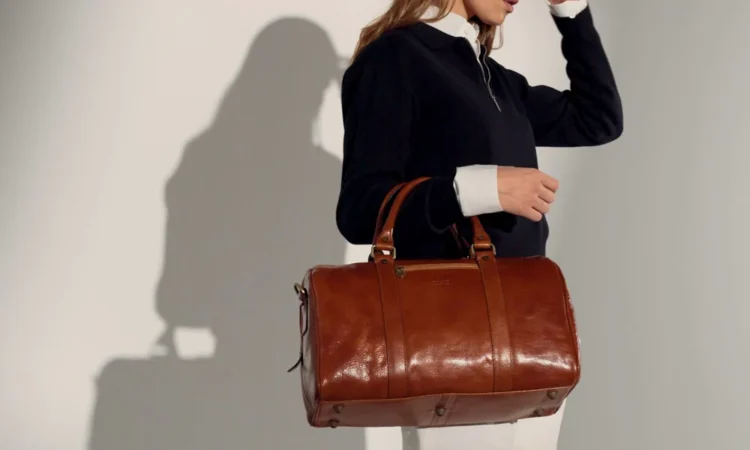

1.Choosing the Right Bag
Patricia rarely rushes when she gets dressed.The clothing itself is usually not the difficult part.Most days she already knows what she wants to wear:a pair of trousers that sit neatly at the waist,a knit top that feels refined yet comfortable,and shoes that give the entire outfit a clear foundation.
The real decision arrives afterward.
Accessories determine whether an outfit feels unfinished or complete,and the most decisive element among them is the women’s bag she chooses to carry.
Matching a bag to clothing has never interested Patricia very much.Matching is simple.What matters more is whether the bag strengthens the direction of the entire outfit.The right bag clarifies the look and allows every garment to work together more convincingly.
Several options may appear on the table before she settles on one.A structured bag may feel elegant but too formal for the rest of the outfit.Another may appear casual yet too soft beside tailored clothing.
The choice that finally remains is rarely the most obvious.
Instead,it is the one that allows the outfit to feel complete and intentional.
Patricia never treats this moment as a minor habit.The first accessory decision often shapes the tone of everything that follows.A bag can bring definition,restraint,or quiet strength to an outfit without changing a single garment.For that reason she prefers to test several possibilities before reaching a final decision.The difference between them may be subtle,yet once the correct bag appears the entire look becomes clearer.
2.Why Some Bags Last
Fashion changes constantly,yet certain bags remain appealing long after a season ends.
What separates these designs from the rest is rarely decoration or popularity.Instead,it is a sense of thoughtful design that continues to feel relevant over time.
A well-made bag supports the clothing around it rather than competing for attention.The leather feels convincing,the strap sits comfortably,and the overall proportion works naturally with the person carrying it.
Studying different references has helped Patricia refine her understanding of these details.She occasionally browses a broader style selection online to see how designers approach materials,structure,and form.These comparisons make it easier to recognize which bags will remain satisfying beyond a single season.
Collecting large numbers of bags has never been her goal.
Instead,Patricia prefers to find a few designs that remain dependable year after year.
Those are the ones that truly matter.
What stays in her wardrobe is not novelty but reliability.The bags she values most continue to look convincing even after years of use.Their appeal does not depend on surprise.It comes from proportion,material,and the sense that every element has been considered carefully.
3.The Importance of Proportion
Proportion plays a decisive role in how an outfit appears.
Clothing and accessories behave like parts of a composition.When one element becomes too dominant,the entire arrangement can feel unsettled.
This is why the size and structure of a women’s bag receive careful attention.
A large bag beside delicate clothing can make the outfit appear heavier than intended.A very small bag may disappear beside garments with stronger lines or volume.
Finding the right relationship between these elements takes observation.
Even a difference of a few centimeters can influence how the look comes together.
When the proportions feel convincing,the outfit appears coherent without needing additional effort.
Patricia has learned that proportion rarely works through dramatic differences.Instead it operates through fine distinctions.A bag that sits too high may shorten the line of the outfit.One that hangs too low may weaken its clarity.These changes are small, yet once noticed they become impossible to ignore.
4.When Color Meets Material
Color relationships often create more visual interest than simple coordination.
Many people assume that a bag must match the clothing they wear.Patricia prefers combinations where the bag introduces a different tone or texture,allowing the outfit to gain depth.
Leather plays an important role in this process.Surfaces with fine grain reflect light differently from matte finishes,and these differences influence how the bag interacts with clothing.
Metal details add another layer.Hardware catches light in subtle ways and contributes to the character of the bag.
Lighting also changes how materials appear.Under daylight a color may appear warmer,while indoor lighting may deepen the tone.
These variations make the relationship between clothing and accessories more interesting.
Well-considered details communicate clearly without excessive decoration.
Material also shapes color in ways that many people overlook.The same shade can appear entirely different depending on the surface of the leather.Under daylight it may reveal warmth,while evening lighting may deepen its character.Patricia appreciates these changes because they allow the bag to interact differently with each outfit.
5.Design Over Decoration
Some bags attract attention immediately because of decorative elements or visible branding.Patricia finds these designs less interesting.
What matters more is how the object contributes to the entire outfit.
When examining a women’s bag,the first thing she studies is the outline.The clarity of the edges,the firmness of the leather,and the proportion between handle and body determine how the bag interacts with clothing.
Certain bags look impressive when displayed alone yet feel awkward once carried.
Others appear modest at first glance but become striking when worn.
Designs in this second category tend to remain appealing for a long time.
A well-designed bag does not rely on decoration to stand out.
Instead,it strengthens the look created by the clothing around it.
Patricia also prefers designs that remain convincing from every angle.Some bags depend too much on a single view,while the rest of the structure feels unresolved.The strongest designs hold together from every direction,where handle,base,and closure all contribute to a clear idea.
6.What Materials Reveal
Materials reveal the true character of a bag.
Before deciding whether a design deserves attention,Patricia studies the edge of the leather carefully.The finishing of that edge can reveal more about craftsmanship than any advertisement.
High-quality leather carries depth and density.It holds its form without stiffness and gradually develops a richer surface through use.
Hardware also influences the final result.Zippers,clasps,and rings should appear deliberate rather than decorative.
When metal elements become overly bright or complicated,they distract from the structure of the bag itself.
Bags built with careful materials and solid construction tend to remain convincing for many years.
Construction matters just as much as appearance.Patricia studies stitching,lining, and the way the bag opens and closes.These details may not appear obvious at first glance,yet they determine whether the design continues to feel persuasive in daily use.
7.How a Bag Looks When Carried
The character of clothing becomes clearer once someone begins walking,and the same is true for a women’s bag.
A bag that appears refined on a table may feel completely different once worn.Straps may slip or the form may sit awkwardly against the body.
These differences become obvious immediately.
When a bag rests naturally against the shoulder and maintains its shape,the entire outfit appears more composed.
If the bag feels uncomfortable or visually disruptive,the look loses clarity.
Because of this,Patricia sometimes sets aside bags she initially admired.A design must feel convincing not only when viewed alone but also when worn as part of an outfit.
Judging a bag while carrying it reveals qualities that photographs never show.Strap placement,height,and structure all become visible once the bag is worn.Patricia relies on this test before deciding whether a design deserves a place in her wardrobe.
8.Patricia’s Approach to Style
Minimalism is often used to describe Patricia’s style,but the word she prefers is precision.
Adding items without purpose rarely improves an outfit.Every element should contribute something meaningful.
This idea becomes especially important when choosing accessories.
A bag should not feel like a last-minute addition.
On some days Patricia begins with the bag and builds the outfit around it.On other days the bag becomes the final decision that clarifies everything else.
Both approaches depend on careful observation.
Personal style grows from selecting the right garments and accessories rather than accumulating more items.
Precision does not remove character from clothing.Instead it allows strong decisions to stand out.When unnecessary additions disappear,the garments that remain appear more deliberate.
9.The Detail That Finishes an Outfit
The final effect of an outfit rarely depends on clothing alone.
Accessories often determine whether the look appears intentional or incomplete.
For this reason,Patricia pays particular attention when selecting a women’s bag.
Sometimes an outfit feels unfinished until the right bag appears.
Once introduced,the lines of the bag echo the structure of the clothing and the entire look begins to feel deliberate.
Several options may be tested before the correct one emerges.
The difference between them may seem small,yet the right bag transforms the outfit completely.
She has noticed that the final accessory choice often changes how others read an outfit.Without the right bag the clothing may appear unresolved.Once the correct bag is introduced,the outfit gains clarity.
10.Fashion vs Personal Style
Fashion moves rapidly.
Colors,silhouettes,and materials gain attention for a season and then disappear again.
Personal style develops differently.
It grows through observation and experience rather than constant change.
A well-chosen bag reflects this philosophy.
If a design remains convincing long after trends have shifted,it has already moved beyond seasonal fashion.
It becomes part of a lasting wardrobe.
Newness alone rarely impresses Patricia.What interests her is whether a design continues to feel relevant once the excitement of a new season fades.
11.The Bag She Chooses Again
Among the bags Patricia owns,one appears in her outfits more frequently than the others.
It is not the newest design in her wardrobe,nor is it the most elaborate.
This women’s bag stands out because of its clarity of form.The leather has developed a richer surface through use,and the hardware carries subtle traces of time.
Whenever she reaches for it,the bag feels familiar yet refined.
Friends sometimes ask why she continues to choose the same bag when new designs appear every season.
Her answer is simple.
Once a bag fits naturally within the rest of the wardrobe,replacing it becomes unnecessary.
Experience has already proved its value.
12.Style Becomes Personal
Style becomes meaningful when it reflects individual judgment.
A bag may be beautifully designed,but its real significance emerges through the way it is chosen and worn.
Patricia does not search endlessly for the newest design.
Instead,she focuses on items that work well with the clothing she already values.
Over time those decisions create a recognizable visual identity.
A well-selected bag strengthens the entire look without demanding attention for itself.
When that happens,the bag becomes more than an accessory.
It becomes part of personal style.